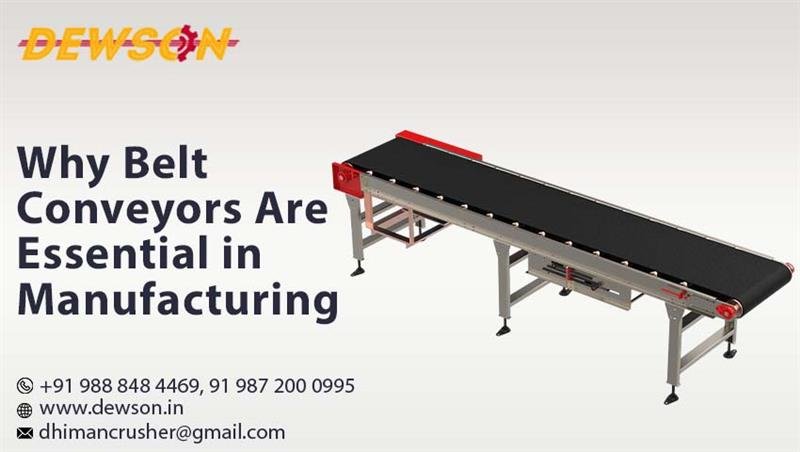


Why Belt Conveyors Are Essential in Manufacturing

Which Conveyor Belt Manufacturer in India Fits Your Industrial Needs?
November 12, 2025
Why India’s Stone Crusher Machines Lead in Tough Jobs
January 14, 2026Speed, precision and fluidity of materials are all the sound of manufacturing these days. Automation here comes in handy. A conveyor assists manufacturing plants to transport substances with ease between various production processes without causing delays or needless effort.
Conveyors are used in the management of raw materials to finished products because the process is organized and standardized. They minimize the use of manual labour and assist factories to have consistent workflow. This blog will touch on the use of belt conveyors to support manufacturing, the practical implementation of the conveyors, considerations that are crucial during the selection and the process of identifying the correct manufacturer.
The Role of Conveyors in Supporting Everyday Manufacturing Processes
Belt conveyors ensure the continuity of flow of materials, which makes machines get inputs in time. This enhances process coordination and decreases the idle time. Employees do not have to put on their hands and move heavy objects; this makes their work safer and more efficient.
Continuous Material Movement in the Factory
In an average manufacturing plant, there is the need to have materials flowed constantly between the machines, workstations, and storage facilities to ensure that production does not stop.
- Production flow made smooth
The conveyors assist in creating a systematic and continuous flow of material through various manufacturing processes. - Better Process Co-ordination
Having the conveyors, various production processes get closer and more interdependent on each other in a designed manner. - Less Manual Handling and an Increased Safety
The workers do not have to bring or move heavy materials manually to a certain place. - Increased Work Productivity and Reduced Work Pressure
A steady stream of materials with time is useful in keeping down production rate.
The Reasons Why Manufacturing Units Rely on Conveyors
The production process is one that necessitates the constant movement of materials through various processes. In the absence of conveyors, this process is time consuming and unreliable.
It will facilitate the operation by ensuring there is flow in the materials. They minimise the use of manual lifting and this minimises fatigue and work-related injuries. When movements are continuous, machines get materials when they are needed, thus eliminating wastage of time. In the long run, this will result in the increased quality of output and reduced costs of operations.
Main Uses of this Conveyors
Belts conveyors are applied in most manufacturing processes due to their flexibility and efficiency.
Common Applications Includes:
- Transportation of raw materials to machines.
- Moving products across workstations.
- Stocking of finished products to packaging zones.
- The work with bulk materials in large amounts.
The fact that they can withstand the continuous loads, makes them appropriate in both light and heavy operations.
The Belt Conveyors and the Way They Enhance Productivity
Conveyor system assists in ensuring a continuous work flow. The flow of materials is slower, which meets the requirements of the machines by supplying them in a timely manner. This minimizes time in waiting during production stages and fits the Industrial needs.
Workers will be able to perform skilled jobs instead of handling the materials in repetitive tasks through automation of the material movement. This enhances productivity and minimises mistakes. In the long run, the flow of materials will translate into an increase in output, quality control, and an increase in delivery schedules.
Operational Benefits
- Belt Conveyor enjoy the reputation of simple designs and maintenance. They are kept running smoothly through regular cleaning, belt alignment and lubrication.
- They use less electricity than other material handling systems and they produce little noise.
- This is to make them affordable and appropriate even during long working hours.
- Conveyors have long service life and performance is consistent when well maintained.
What are the Features of a Reliable Conveyor Manufacturer
A conveyor system is greatly dependent on how it is built. An excellent manufacturer pays attention to the high quality of construction, reliability of used materials, high-quality engineering and customization of systems with proper certifications.
There is also the testing, guidance on proper installation and reliable after sales support. These are the attributes of a good belt conveyor manufacturer and it has a direct influence on the system reliability and customer satisfaction.
Choosing the Correct Conveyor to use in a Smooth Process
- Compare the Conveyor and Process Flow
The conveyor must follow the movement of the materials between different stages of production to eliminate delays or congestions. - Plan for Space Optimization
The space available on the floor and the positioning of the equipment determine the required method of compact conveyor, modular conveyor or extended conveyor. - Select the Right Configuration
Depending on the change in elevation and direction, horizontal, inclined or curved conveyors must be chosen. - Environmental Exposure to Be Taken into Account
The presence of such factors as dust, moisture, heat or exposure to the outdoors affect the durability of belt material and systems.
Difference in Conveyor System or Manual Handling
Aspect manual handling conveyor system.
| Aspect | Manual handling | Conveyor system |
| Work speed | Slow | Continuous |
| Labor effort | High | Minimal |
| Safety level | Risky | Safer |
| Consistency | Uneven | Stable |
| Long-term cost | Higher | Lower |
This analogy explains the popularity of conveyors in the contemporary manufacturing plant.
Final Thoughts
Belt conveyors have recently become a necessity of the contemporary manufacturing as they can enhance efficiency, safety, and consistency. They reduce dependence on labor, make material handling much easier, and promote flow of production. The selection of the appropriate conveyor system and a trusted manufacturer are the keys to success in terms of the long-term operation. (DEWSON) Dhiman engineering works with solid engineering skills, robust designs, and solutions unique to the industry, will help the manufacturers to develop efficient and reliable material handling systems.
FAQs
Q1: Is this an appropriate choice of a small factory?
A: Yes, they are employees of big and small units.
Q2: Are these associated with fatigue reduction of workers?
A: Yes, they cut lifting work.
Q3: Does maintenance of conveyors become hard?
A: No, it is sufficient due to some basic maintenance.
Q4: Do conveyor systems assist in increasing the speed of production?
A: Yes, they keep work moving.